
The City of Amarillo actively manages mosquito populations by treating over 100 sites around the city. This treatment is necessary when environmental conditions create stagnant standing water, which is ideal for mosquito larvae to start hatching.
- CONTACT INFORMATION
- ehealth@amarillo.gov
-
Food Establishments, Mosquito Control, Swimming Pools, Complaints:
806-378-9472 -
In-Person:
Simms Municipal Building
Suite 275
808 S Buchanan St
Amarillo, TX 79101 -
Mailing Address:
Env. Health Dept.
PO Box 1971
Amarillo, TX 79101
Mosquito Control Details
Prevent Mosquitoes on Your Property
Female mosquitoes lay their eggs in stagnant water. To help prevent mosquitoes from breeding on your property:
- Dump and drain any standing water (e.g., in pet bowls, trash, or pools).
- Cover or drain pools when not in use.
- Remove any items that may collect water.
Environmental Health Mosquito Control Methods
The Environmental Health Department works to control mosquito populations through various methods.
- Space Spraying involves using an ultra-low volume machine to dispense pesticide into the air, effectively killing adult mosquitoes.
- Larviciding is a method of mosquito control that targets mosquito larvae in standing water. By killing the larvae, it prevents them from developing into adult female mosquitoes that bite.
- Larviciding Areas
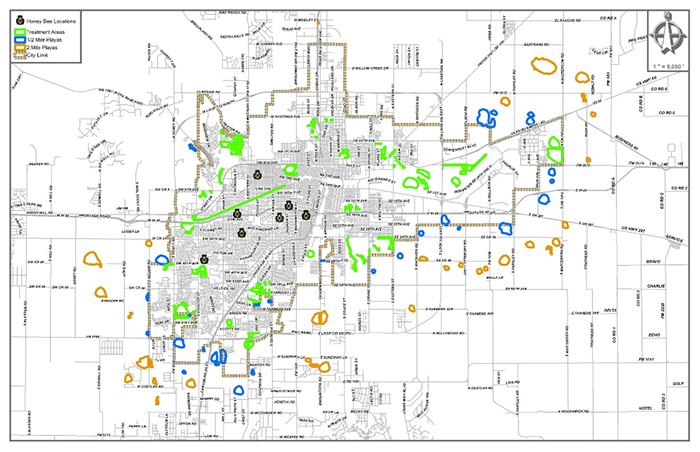
- The map below shows the major larviciding areas within the City of Amarillo by zip code. Green squares indicate the primary areas of focus. Additionally, uncurbed ditches throughout the city are also treated to control mosquito populations.
Mosquito Control FAQS
Will you come spray my private property for mosquitos?
No. The City of Amarillo does not spray private residences or private property.
Our mosquito control efforts focus on public rights-of-way, parks, drainage areas, and other public spaces with high mosquito activity.
We encourage residents to:
Eliminate standing water around their homes.
Keep lawns trimmed and landscaping maintained.
Report mosquito activity using our form: Mosquito Report Form
Reports help our Environmental Health team monitor mosquito hotspots and prioritize public treatment zones during the active season.
Will you come spray for mosquitos if I reside outside the limits of Amarillo?
No. The City of Amarillo’s mosquito control program only operates within city limits.
If you live outside Amarillo, check with your local municipality. For example, the City of Canyon and Village of Lake Tanglewood have their own mosquito control programs.
What chemicals does the City use to control mosquitoes, and are they safe?
The City uses EPA-registered insecticides, including:
Bio-Mist 30-30
Perm-X 4-4
Mosquito Master 412
These are applied using ULV (Ultra-Low Volume) fogging, which disperses a fine mist to target adult mosquitoes while using minimal chemical amounts. When applied properly by trained professionals, they pose minimal risk to people, pets, and the environment.
Could the mosquito spray harm my pets or animals?
When used properly, the insecticides used by the City are not expected to harm pets or animals.
As a precaution, you may wish to bring pets indoors during active spraying. ULV fogging uses a small volume of product that breaks down quickly in the environment.
Will the mosquito spray damage my garden or make my vegetables unsafe to eat?
No, but you should take normal food safety precautions.
The insecticides are not meant to be sprayed directly on edible plants.
ULV fogging minimizes drift, but trace exposure is possible.
As a general rule, always rinse fruits and vegetables before consuming — just like you would with produce from a store or farmer’s market.
Can spraying for mosquitos negatively impact pollinators?
Yes. Bees and other pollinators can be sensitive to insecticides.
The City takes the following steps to reduce impact:
- Spraying is conducted in the evening or early morning when bees are typically inactive.
- ULV application uses very small amounts of product, minimizing off-target exposure.
- Residents with hives may report their address to ehealth@amarillo.gov and our applicators will avoid those areas.
I still see mosquitoes after spraying. Does that mean it didn’t work?
Not necessarily. Spraying helps reduce mosquito populations but won’t eliminate them completely:
Only adult mosquitoes that are active and flying at the time of treatment are affected.
Mosquitoes may migrate from untreated or nearby areas.
Spraying is just one part of the City’s Integrated Mosquito Management (IMM) strategy, which includes:
Mosquito trapping and monitoring
Larval control (targeting immature mosquitoes in water)
Standing water elimination
Community education
How often does the City spray for mosquitoes, and when does the season start?
Spraying typically occurs between April and October, depending on weather conditions.
There is no fixed schedule. Instead, spraying is based on:
Mosquito trap counts
Public complaints
Weather conditions
Disease risk factors (like West Nile virus)
Neighborhoods with more mosquito activity may receive multiple treatments per season.
How quickly does mosquito spraying begin to work?
The chemicals used begin to kill flying adult mosquitoes on contact, usually within minutes to a few hours of application.
The highest level of effectiveness is usually observed the same evening the treatment takes place.
Why doesn’t the City spray more often or more aggressively?
We follow EPA label instructions and industry best practices to:
Avoid chemical overuse
Prevent mosquito resistance to insecticides
Protect beneficial insects and the environment
Spraying is done only when needed, based on science and surveillance data.
Could the chemicals used in mosquito control cause cancer or health problems?
The active ingredients in the City’s products are EPA-reviewed and considered safe when applied according to label directions.
All applications are made by trained City staff following strict guidelines.
Public health and environmental safety are priorities in all mosquito control operations.